Forget the Open Concept: Why "Broken-Plan" Kitchens & Hidden Prep Zones Are The New Status Symbol
The era of the cavernous, fully open-plan kitchen is waning. Homeowners are rediscovering the value of separation, privacy, and dedicated functional zones. Enter the "broken-plan" layout: a sophisticated design approach that uses architectural elements like partial walls, glass partitions, and clever cabinetry to create distinct spaces within a larger footprint. The ultimate expression of this trend is the hidden prep zone or scullery—a secondary workspace where the messy business of cooking happens, leaving the main kitchen pristine for entertaining. It's the new standard of luxury, blending the social benefits of open living with the practical needs of a working home.
The Moody Industrial Scullery
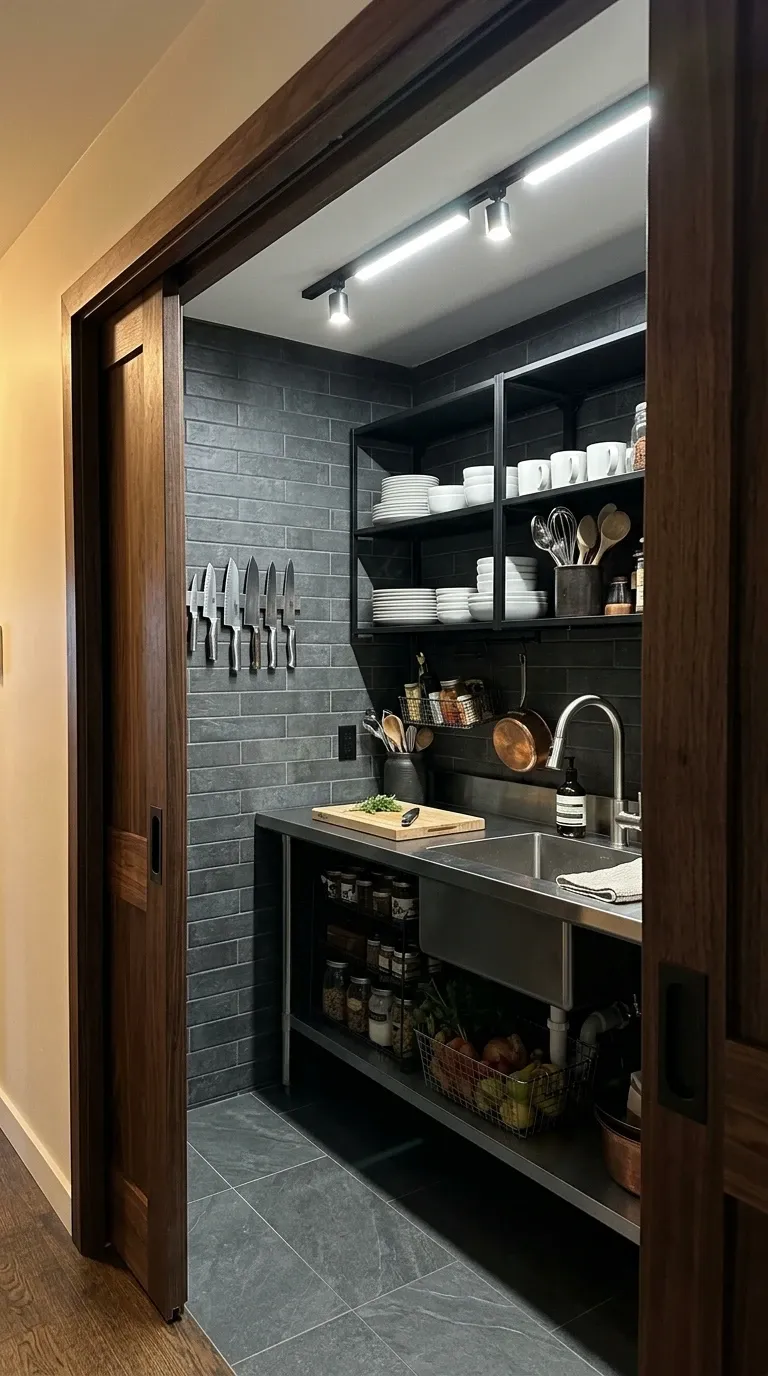
This hidden prep zone embraces a dark, moody aesthetic that contrasts beautifully with a brighter main kitchen. Tucked behind a substantial dark wood sliding door, it features floor-to-ceiling dark grey subway tiles and functional stainless steel elements. Open black shelving keeps essentials within reach, while track lighting ensures the space is bright enough for detailed work. It's a perfect example of a utilitarian space that doesn't sacrifice style.
Features
- Floor-to-ceiling dark grey subway tile
- Stainless steel prep table with integrated sink
- Black metal open shelving
- Track lighting
- Magnetic knife strip
- Sliding dark wood barn door
Cost Analysis
| Decor Item (Qty) | Total Price Range |
|---|---|
| Dark grey subway tiles & installation (approx. 80 sq ft) | $800 – $1,600 |
| Stainless steel prep table with sink | $800 – $1,500 |
| Black metal open shelving unit | $300 – $600 |
| Track lighting system (x2 heads) | $150 – $300 |
| Magnetic knife strip & knife set | $250 – $500 |
| Misc. decor (copper pots, baskets, cutting board) | $300 – $600 |
| Dark wood sliding barn door & hardware | $1,000 – $2,000 |
| Total Estimated Cost | $3,600 – $7,100 |
Tips & Guidelines
- Use dark colors to make a small, windowless space feel intentional and cozy.
- Excellent task lighting is non-negotiable in a prep zone.
- Open shelving is practical for grab-and-go items but requires curation to look tidy.
The Classical Pass-Through Pantry
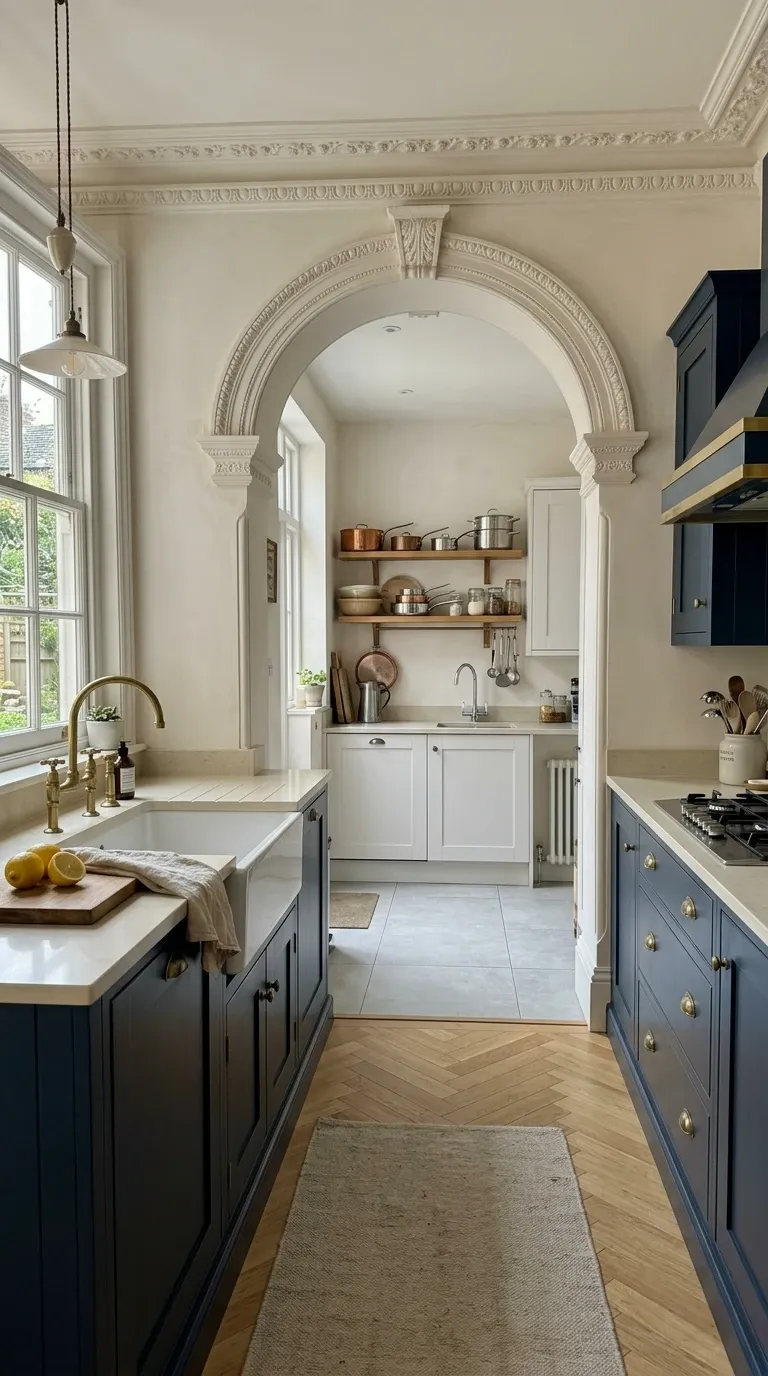
A stunning ornate archway frames this elegant scullery, turning a functional pass-through into a design feature. The space blends classic Victorian elements like shaker cabinets and brass hardware with a light and airy palette. Open wooden shelves display copper cookware, adding warmth. The herringbone floor leads the eye through the space, connecting it to the main kitchen while maintaining a distinct identity.
Features
- Decorative plaster archway
- Two-tone shaker cabinetry (navy and white)
- Brass bridge faucet and hardware
- Open wooden floating shelves
- Herringbone wood flooring
- Apron-front farmhouse sink
Cost Analysis
| Decor Item (Qty) | Total Price Range |
|---|---|
| Custom archway molding & installation | $1,500 – $3,000 |
| Shaker cabinetry (base & upper) | $3,000 – $6,000 |
| Quartz countertops | $1,500 – $3,000 |
| Brass bridge faucet & farmhouse sink | $1,000 – $2,000 |
| Floating wooden shelves (x2) | $200 – $400 |
| Herringbone wood flooring (small area) | $800 – $1,600 |
| Pendant light & decor | $400 – $800 |
| Total Estimated Cost | $8,400 – $16,800 |
Tips & Guidelines
- An architectural feature like an archway elevates a simple passage.
- Mix cabinet colors (dark base, light upper) to add visual interest.
- Display beautiful cookware like copper pots to double as decor.
The Sleek Hidden Coffee Bar
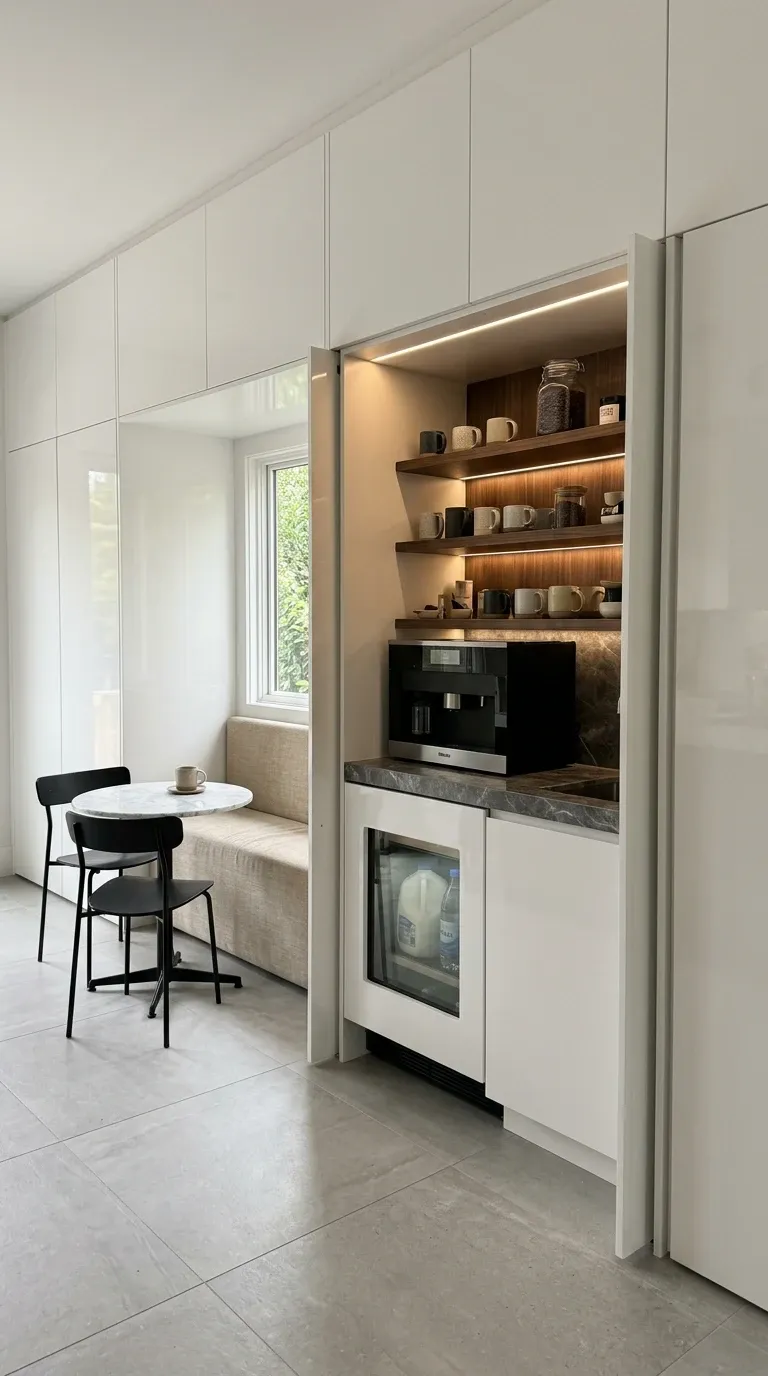
For the ultimate in minimalist luxury, this coffee bar and beverage station can be completely concealed behind floor-to-ceiling pocket doors. When open, it reveals a beautifully appointed nook with walnut shelving, integrated lighting, a built-in coffee machine, and a beverage cooler. The high-gloss white cabinetry reflects light, making the space feel larger and more modern.
Features
- Floor-to-ceiling high-gloss white cabinetry with pocket doors
- Built-in coffee system
- Undercounter beverage cooler
- Walnut floating shelves with integrated LED lighting
- Marble countertop and backsplash
Cost Analysis
| Decor Item (Qty) | Total Price Range |
|---|---|
| Custom high-gloss cabinetry with pocket door hardware | $5,000 – $10,000 |
| Built-in coffee system (e.g., Miele) | $3,500 – $5,000 |
| Undercounter beverage cooler | $1,000 – $2,000 |
| Marble countertop & backsplash slab | $1,500 – $3,000 |
| Walnut floating shelves (x3) with LED | $1,200 – $2,400 |
| Small bistro table & chairs (x2) | $600 – $1,200 |
| Total Estimated Cost | $12,800 – $23,600 |
Tips & Guidelines
- Pocket doors are essential for a truly hidden station that doesn't block flow when open.
- Invest in built-in appliances for a seamless, high-end look.
- Integrated LED strip lighting highlights the materials and creates ambiance.
Zoned Dining with Wood Slat Feature
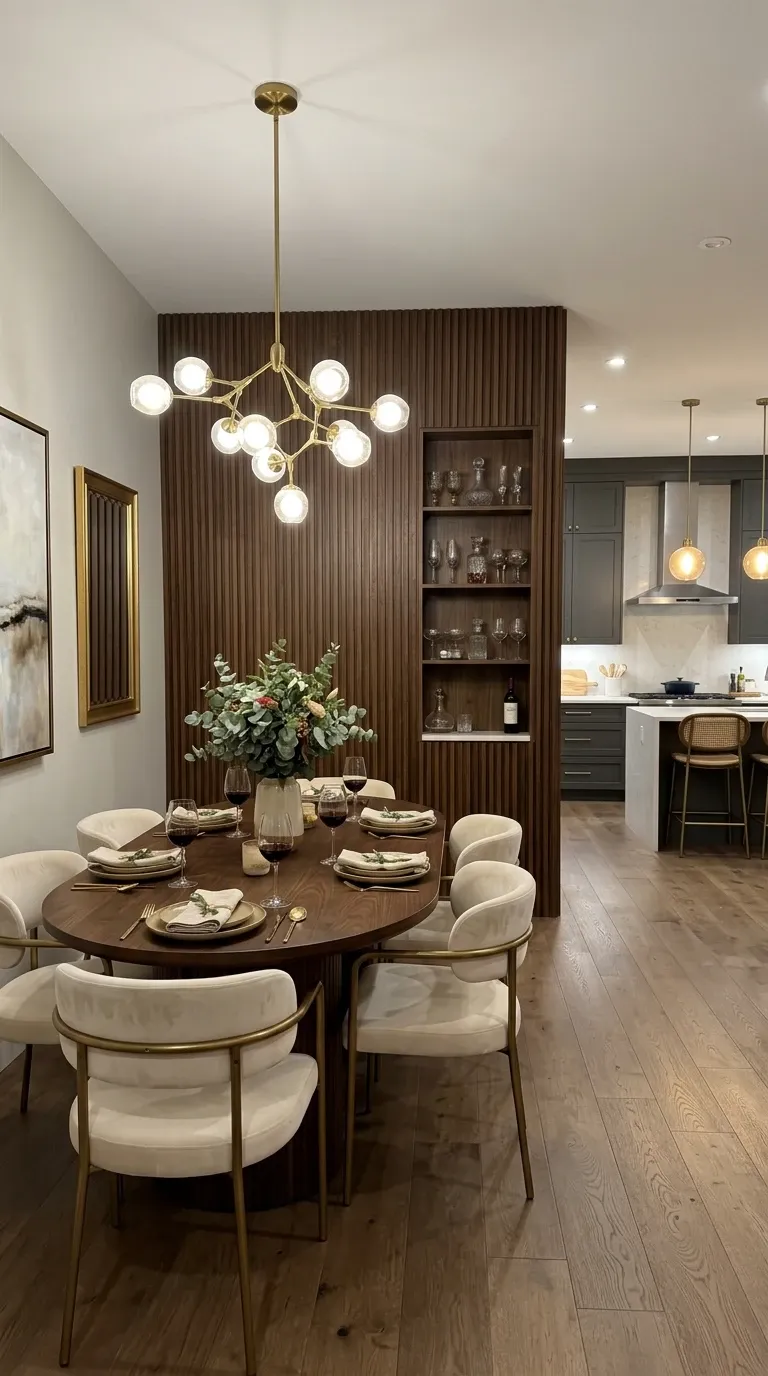
This dining area demonstrates the "broken-plan" concept by using a feature wall to define the zone without fully enclosing it. The vertical wood slat wall provides texture and warmth, visually separating the dining space from the adjacent kitchen. A built-in niche within the wall serves as a stylish bar, adding functionality right where it's needed for entertaining.
Features
- Vertical wood slat feature wall
- Built-in bar niche with glass shelving
- Modern brass sculptural chandelier
- Oval walnut dining table
- Cream velvet dining chairs with brass frames (x6)
Cost Analysis
| Decor Item (Qty) | Total Price Range |
|---|---|
| Wood slat wall installation & materials | $2,000 – $4,000 |
| Built-in bar niche (shelving & lighting) | $1,500 – $3,000 |
| Modern brass sculptural chandelier | $800 – $1,600 |
| Oval walnut dining table | $2,000 – $4,000 |
| Velvet dining chairs (x6) | $1,800 – $3,600 |
| Tableware, centerpiece & bar decor | $600 – $1,200 |
| Total Estimated Cost | $8,700 – $17,400 |
Tips & Guidelines
- Use textured wall treatments like wood slats to define a space visually.
- A built-in bar niche is a great space-saving alternative to a freestanding bar cart.
- Carry material accents, like brass, throughout the lighting and furniture for cohesion.
Dining Nook with Walnut Divider
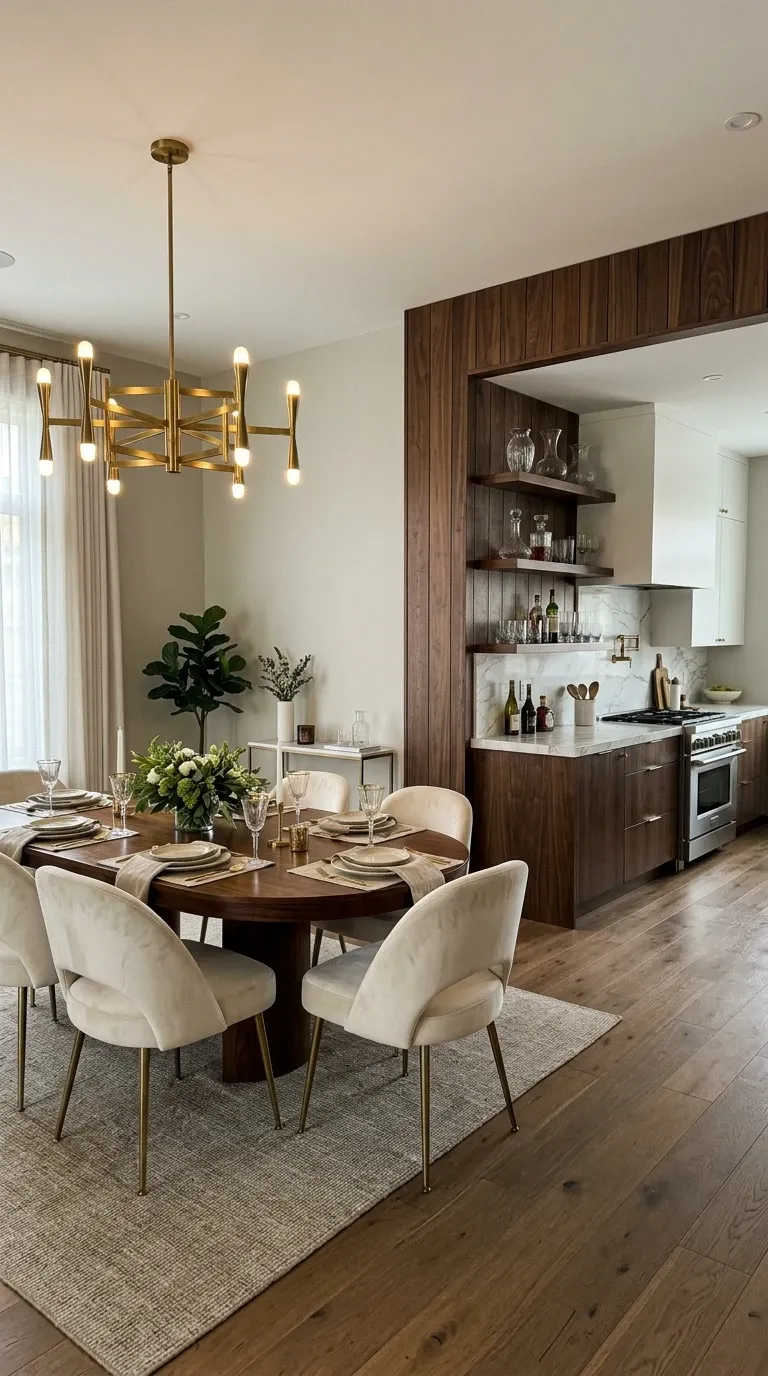
A substantial walnut wood partition creates a sense of intimacy and separation for this dining nook, breaking up the open plan without sacrificing light or sightlines. The rich wood tone of the divider is echoed in the dining table and the kitchen cabinetry beyond, creating a cohesive design. This creates a distinct "room within a room" feeling.
Features
- Walnut wood partition/archway
- Round walnut dining table
- Cream velvet dining chairs with brass legs (x6)
- Modern brass chandelier
- Large textured area rug
- Fiddle leaf fig plant
Cost Analysis
| Decor Item (Qty) | Total Price Range |
|---|---|
| Custom walnut wood partition/archway | $3,000 – $6,000 |
| Modern brass chandelier | $800 – $1,500 |
| Round walnut dining table | $1,500 – $3,000 |
| Velvet dining chairs (x6) | $1,500 – $3,000 |
| Large textured area rug | $600 – $1,200 |
| Bar cart & accessories | $400 – $800 |
| Large potted plant & decor | $300 – $600 |
| Total Estimated Cost | $8,100 – $16,100 |
Tips & Guidelines
- A partial wall or wide archway is a perfect 'broken-plan' solution.
- Use a large area rug to further define the dining zone on the floor.
- Consistent use of wood tones ties the separated spaces together.
The Cottagecore Walk-in Pantry
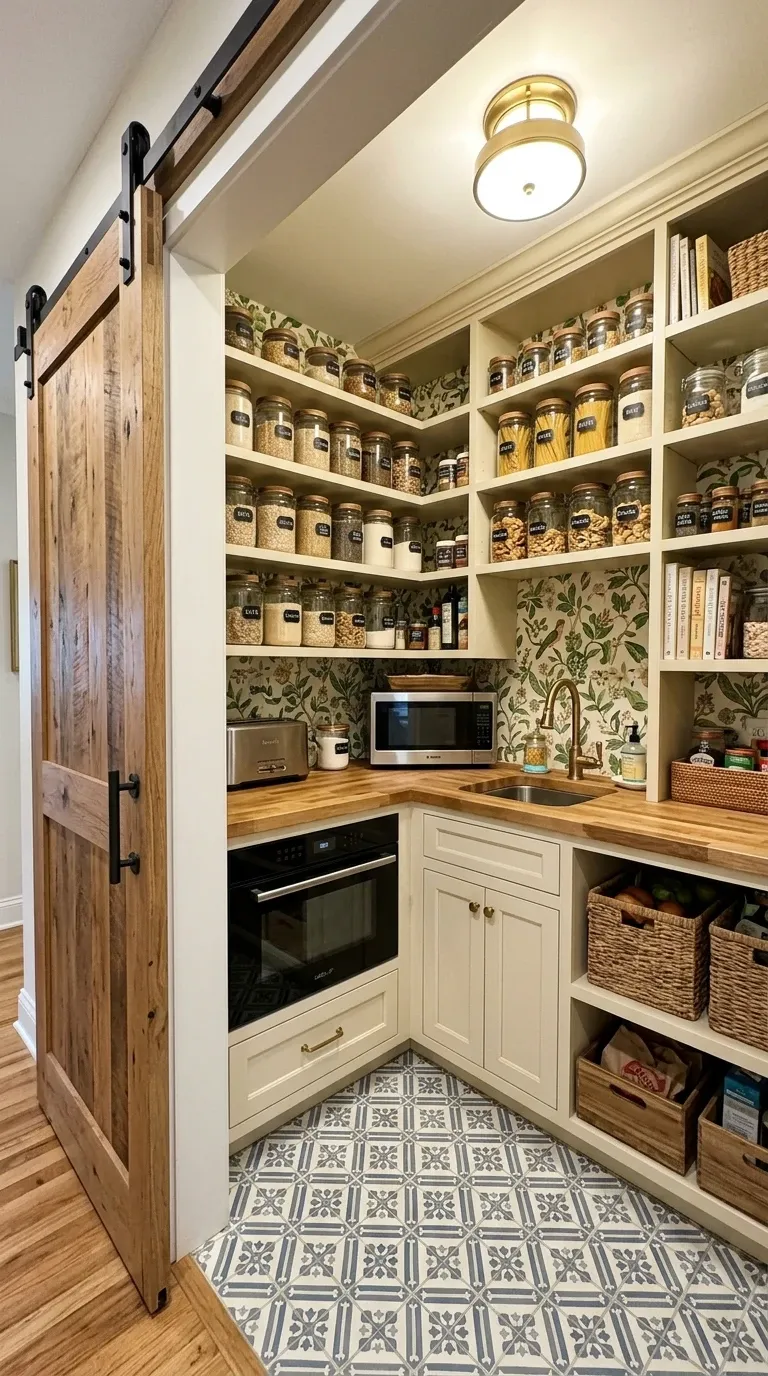
This charming walk-in pantry proves that utilitarian spaces can be beautiful. A lively floral wallpaper provides a whimsical backdrop for cream shaker cabinets and warm butcher block countertops. Patterned floor tiles add another layer of visual interest. The space is highly functional with a mix of open shelving for easily accessible jars and closed cabinetry for appliances.
Features
- Floral wallpaper
- Cream shaker-style cabinetry
- Butcher block countertops
- Patterned ceramic floor tile
- Open upper shelving with brackets
- Rustic wood barn door
- Built-in microwave and oven
Cost Analysis
| Decor Item (Qty) | Total Price Range |
|---|---|
| Wallpaper & installation | $500 – $1,000 |
| Cream shaker cabinetry | $3,000 – $5,000 |
| Butcher block countertops | $800 – $1,500 |
| Patterned floor tile & installation | $1,000 – $2,000 |
| Built-in microwave & oven | $2,000 – $4,000 |
| Storage jars, baskets & decor | $600 – $1,200 |
| Rustic barn door & hardware | $800 – $1,500 |
| Total Estimated Cost | $8,700 – $16,200 |
Tips & Guidelines
- Don't be afraid to use bold wallpaper in a small, contained space like a pantry.
- Decanting dry goods into uniform glass jars reduces visual clutter on open shelves.
- Butcher block is a cost-effective and warm countertop choice for a pantry.
The Fireplace as a Central Divider
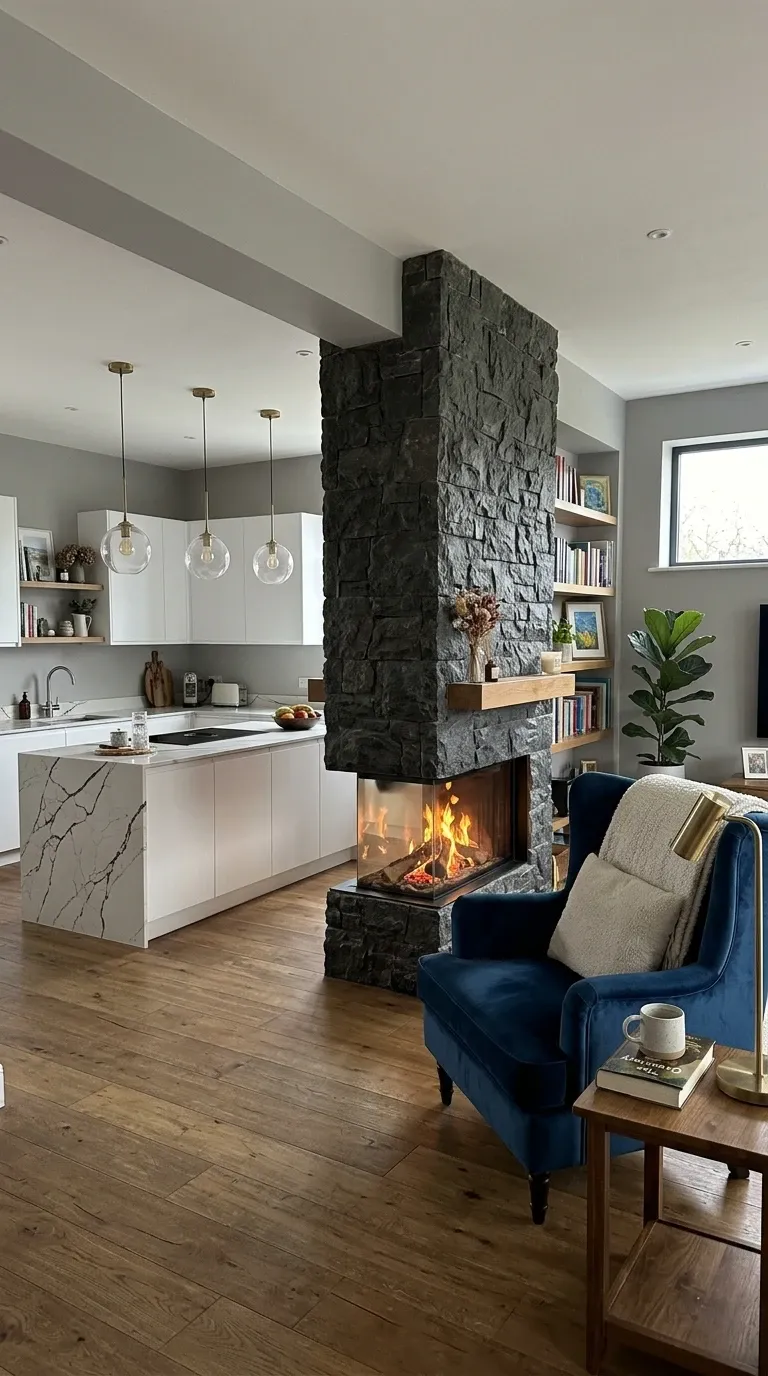
A massive, floor-to-ceiling stone fireplace acts as a dramatic central spine, effectively dividing the kitchen from the living area. This is a prime example of broken-plan architecture, where a central structure creates distinct zones while allowing flow around it. The double-sided fireplace can be enjoyed from both the cooking and lounge spaces, anchoring the entire design.
Features
- Floor-to-ceiling stacked stone double-sided fireplace
- Blue velvet armchair
- Floating wooden shelves in alcove
- Modern minimalist kitchen in background
- Wide plank wood flooring
Cost Analysis
| Decor Item (Qty) | Total Price Range |
|---|---|
| Stone veneer fireplace construction with double-sided gas insert | $12,000 – $22,000 |
| Blue velvet armchair | $800 – $1,500 |
| Side table & floor lamp | $400 – $800 |
| Floating wooden shelves (x4) | $400 – $800 |
| Kitchen pendant lights (x3) | $300 – $600 |
| Total Estimated Cost | $13,900 – $25,700 |
Tips & Guidelines
- A central fireplace is a substantial investment but creates an unbeatable focal point and divider.
- Ensure the materials of the divider (like stone) complement the finishes in both adjoining spaces.
- Utilize alcoves created by the fireplace structure for shelving or seating.
The Professional Chef's Prep Kitchen
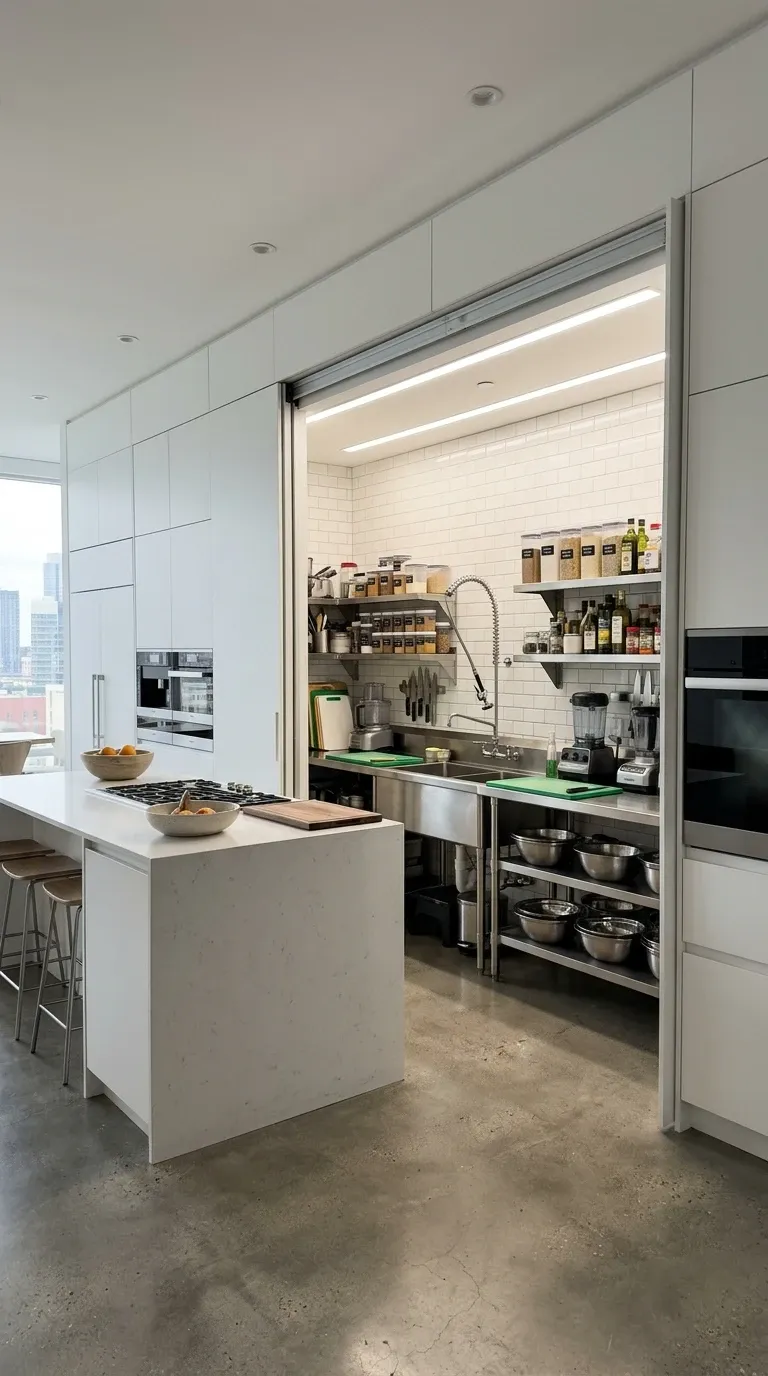
Hidden behind a large sliding wall, this space is a serious cook's dream. It's a purely functional, commercial-grade prep kitchen modeled after a restaurant back-of-house. Stainless steel prep tables, sinks, and open wire shelving are prioritized for durability and hygiene. White subway tiles and a concrete floor complete the industrial, no-nonsense aesthetic, keeping the main kitchen show-ready.
Features
- Floor-to-ceiling white subway tile
- Stainless steel commercial shelving units
- Stainless steel prep table with double sinks and commercial faucet
- Polished concrete floor
- Large white sliding partition door
Cost Analysis
| Decor Item (Qty) | Total Price Range |
|---|---|
| White subway tile & installation (large area) | $2,500 – $4,500 |
| Stainless steel commercial shelving units (x2) | $800 – $1,600 |
| Stainless steel prep table with double sinks | $1,500 – $2,500 |
| Commercial-style pre-rinse faucet | $400 – $800 |
| Concrete floor polishing & sealing | $1,200 – $2,400 |
| Large custom sliding door panel & track | $2,000 – $4,000 |
| Total Estimated Cost | $8,400 – $15,800 |
Tips & Guidelines
- For a true prep kitchen, prioritize materials that are durable and easy to sanitize, like stainless steel.
- Install a commercial-style faucet with a sprayer for easy cleaning of large pots.
- Open wire shelving prevents dust buildup and allows for clear visibility of contents.
The Botanical Pantry & Breakfast Nook
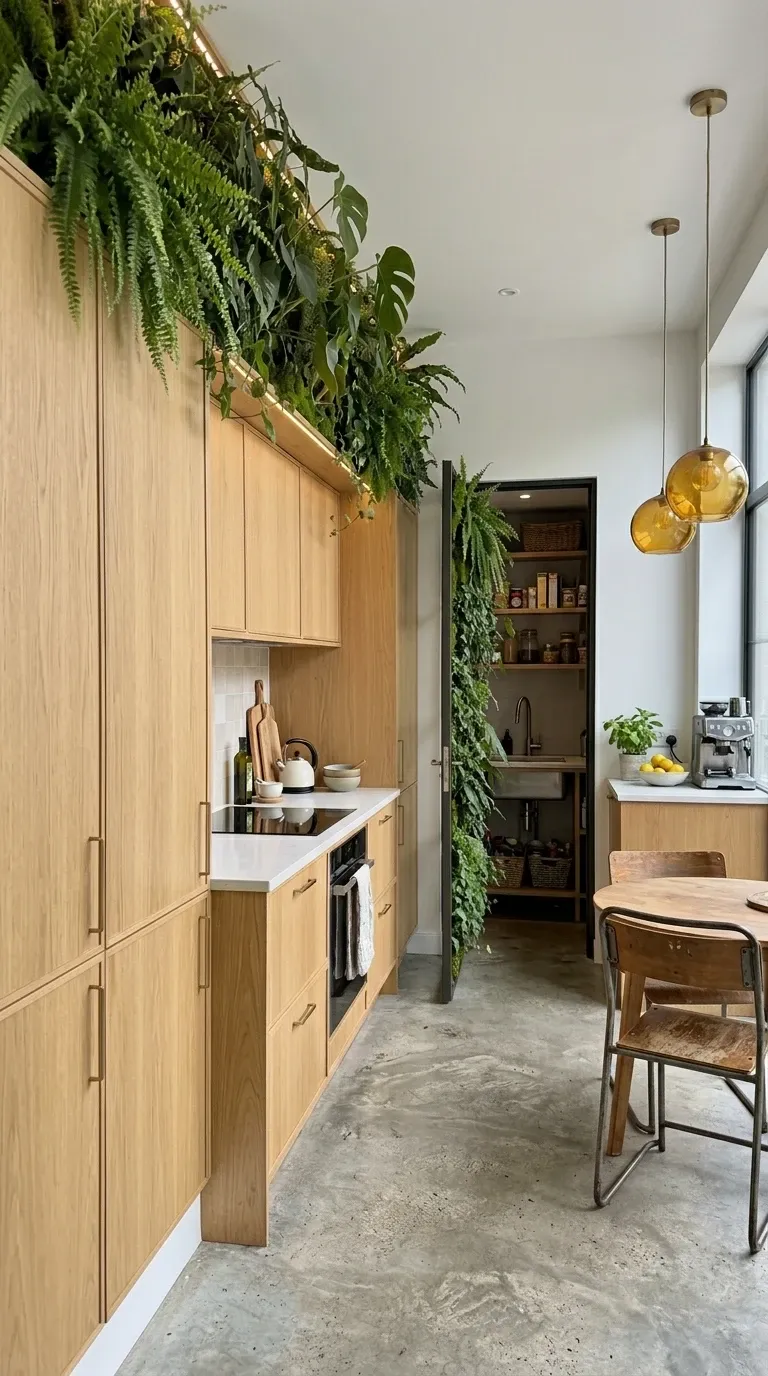
This unique space blurs the line between a pantry and a greenhouse. Light oak cabinetry is topped with an abundance of trailing plants, drawing the eye upwards. A vertical garden on the pantry door itself is a stunning living feature. The natural wood, concrete floors, and greenery create a fresh, organic atmosphere that feels like a breath of fresh air.
Features
- Light oak flat-panel cabinetry
- Abundant trailing plants (ferns, monstera) on cabinet tops
- Vertical garden/green wall on pantry door
- Concrete floor
- Vintage-style wood and metal bistro set
- Amber glass pendant lights
Cost Analysis
| Decor Item (Qty) | Total Price Range |
|---|---|
| Light oak cabinetry | $4,000 – $7,000 |
| Quartz countertop | $1,000 – $2,000 |
| Extensive collection of plants & planters | $800 – $1,500 |
| Vertical garden installation on door | $600 – $1,200 |
| Amber glass pendant lights (x2) | $300 – $600 |
| Vintage-style bistro table & chairs | $500 – $1,000 |
| Total Estimated Cost | $7,200 – $13,300 |
Tips & Guidelines
- Incorporating plants is a fantastic way to soften the look of a utility space.
- Ensure you have adequate natural light or install grow lights to keep plants healthy.
- A vertical garden on a door is a brilliant space-saving solution for adding greenery.
The Glamorous Fluted Glass Butler's Pantry
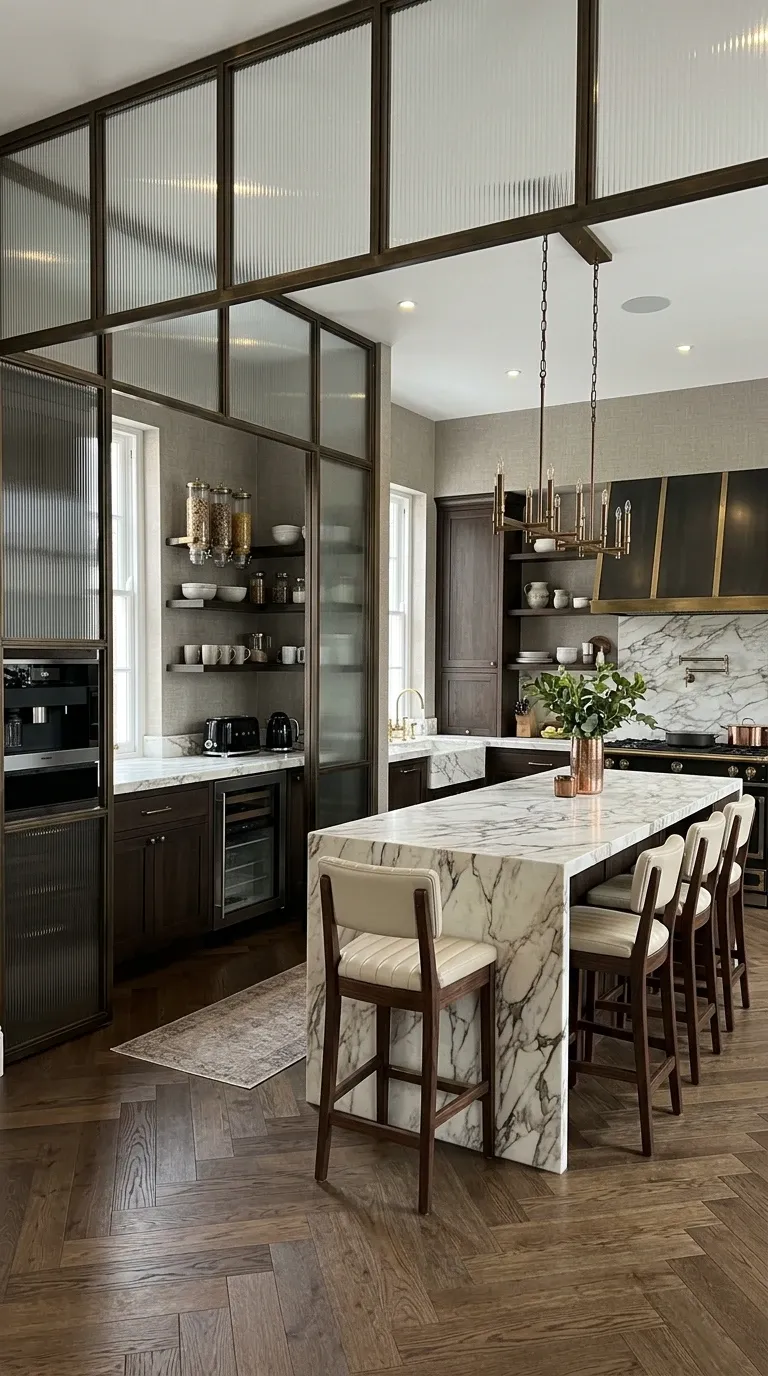
This is the epitome of broken-plan luxury. A spectacular custom partition made of metal and fluted glass separates a fully equipped butler's pantry from the main kitchen. The fluted glass offers a degree of privacy while allowing light to filter through, creating a beautiful shimmering effect. Inside, dark cabinetry, marble countertops, and herringbone floors continue the high-end aesthetic.
Features
- Custom fluted glass and bronze-finish metal partition wall and doors
- Marble waterfall island
- Dark wood cabinetry in pantry
- Herringbone wood flooring
- Brass linear chandeliers (x2)
- Upholstered counter stools (x4)
Cost Analysis
| Decor Item (Qty) | Total Price Range |
|---|---|
| Custom fluted glass & metal partition system | $12,000 – $25,000 |
| Marble waterfall island (main kitchen) | $8,000 – $15,000 |
| Dark wood cabinetry (pantry section) | $5,000 – $10,000 |
| Herringbone wood flooring (large area) | $3,500 – $7,000 |
| Brass linear chandeliers (x2) | $1,600 – $3,200 |
| Upholstered counter stools (x4) | $1,600 – $3,200 |
| Total Estimated Cost | $31,700 – $63,400 |
Tips & Guidelines
- Fluted glass is a top material trend for partitions, offering both glamour and semi-privacy.
- Treat the butler's pantry with the same design level as the main kitchen for a cohesive luxury feel.
- A glass partition is perfect for defining a zone without making it feel small or dark.
Pro Tips & Advice
- Analyze Your Workflow: Before designing a hidden zone, identify the tasks that create the most mess or clutter (e.g., coffee making, vegetable prep, baking). Dedicate your new space specifically to those activities.
- Don't Skimp on Lighting: Hidden spaces often lack windows. Plan for excellent task lighting, such as under-cabinet LED strips or focused track lighting, to make the space functional.
- Define Zones with Texture: In a broken-plan layout, use changes in materials—like a wood slat wall, a different floor tile, or a shift in paint color—to visually signal a change in zone without needing a physical wall.
Cost-Saving Tips
- Door Alternatives: Custom pocket doors can be pricey. Consider a stylish barn door, a simple hinged door, or even a high-quality curtain to conceal your prep zone for a fraction of the cost.
- Mix Cabinetry Tiers: Use high-end, custom cabinetry for the main kitchen facade that everyone sees, and opt for more affordable, standard cabinetry (like IKEA) inside the hidden pantry or scullery.
- Embrace Open Shelving: Upper cabinets are expensive. In a scullery or pantry, open shelving is not only cheaper but also more practical for seeing and accessing items quickly. Just keep it organized!
Final Result & Atmosphere
- The result of adopting a broken-plan approach with hidden zones is a home that feels perpetually calmer and more organized. The main living and entertaining areas remain serene and clutter-free, as the 'work' of the home is contained in dedicated spaces.
- There is a distinct sense of luxury and thoughtfulness in this design. It signals that the homeowner values both social connection and the practicalities of daily life, refusing to compromise on either.
- Ultimately, it creates a home with a better flow and a more sophisticated atmosphere, where every activity has its rightful, and sometimes hidden, place.
Conclusion
The open-concept kitchen had its day, but the pendulum is swinging back towards floor plans that offer more separation and functionality. The broken-plan kitchen, with its hidden sculleries and dedicated prep zones, represents the best of both worlds: a sense of openness and connection, balanced with the privacy and utility we crave. It's a design evolution that acknowledges that while we love to live together, we also need spaces to work, make a mess, and then simply close the door.

No comment