
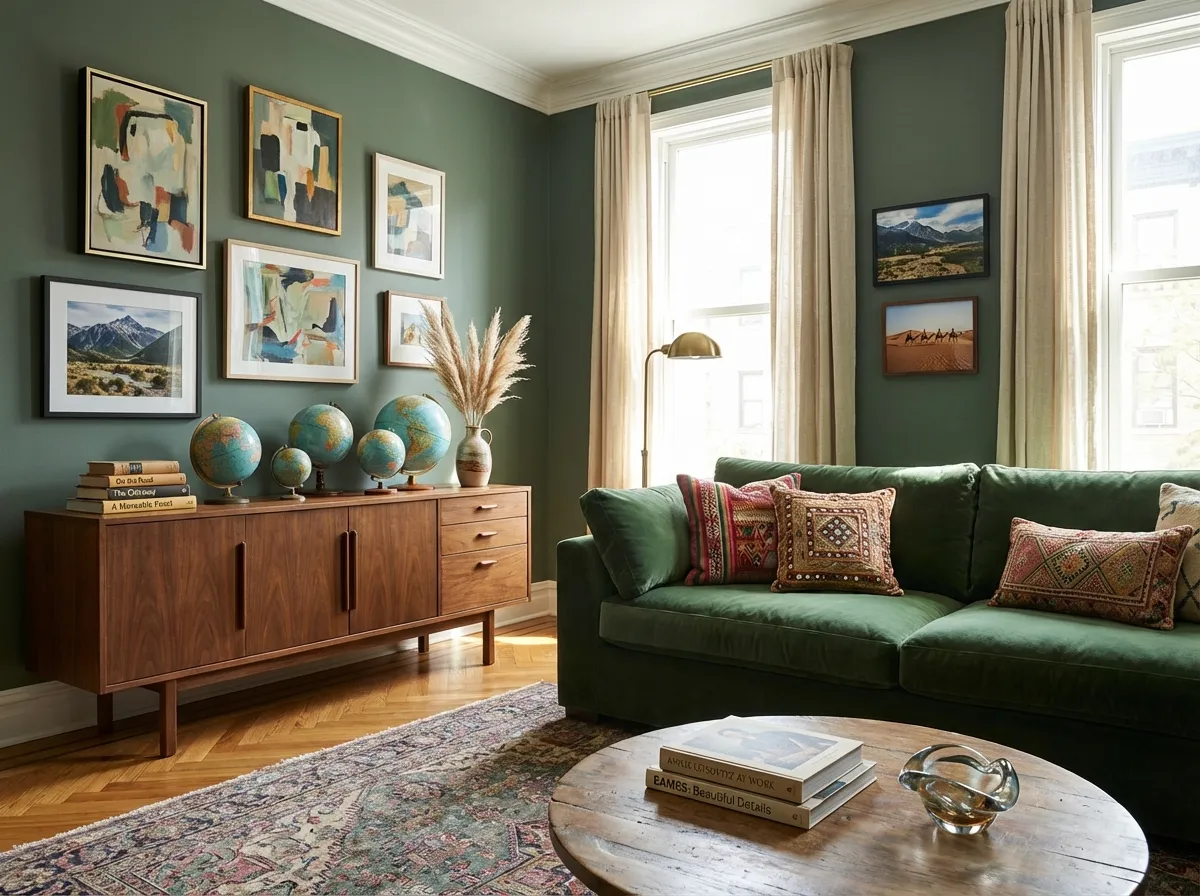
The Unspoken Autobiography: Reading the Home You Already Live In
After twelve years of walking into other people’s homes as a residential designer, here is what I have stopped being surprised by: within the first thirty seconds of stepping inside, I already know more about the people who live there than I would learn in an hour of conversation. I don’t mean this mystically. I mean that every home is writing, in the language of objects and layout and color, a quiet autobiography its owners don’t realize they’re publishing. Some of what a home reveals is deliberate — a curated gallery wall, a chosen paint color, a chair positioned to catch the morning light. But most of what it reveals is accidental: the stack of unopened mail by the door, the one room that never gets shown, the particular object on the nightstand that tells the real story of what kept someone up last week. This essay isn’t about whether your home is beautiful. Plenty of homes I’ve consulted on were magazine candidates and still told a lonely story. Others, small and chaotic, told the richest ones. What I’m interested in — and what environmental psychologists and residential designers have been writing about since the 1970s — is what the space you live in is quietly saying about who you actually are. Not the curated version. The real one.
The Psychology of Place Identity
In 1978, a group of environmental psychologists at the CUNY Graduate Center began publishing a series of papers introducing a concept they called place-identity — the idea that our physical surroundings aren’t just the backdrop of our lives but an active part of how we define ourselves. Harold Proshansky and his co-authors argued that the rooms, streets, and objects we habitually inhabit become woven into our self-concept as much as our profession or our relationships. I read that paper in graduate school and dismissed it as academic. Twelve years of consulting changed my mind. Here is the version of place-identity I see in practice: a couple in Cedar Park hires me to redesign their 1990s tract home. She grew up on a Minnesota farm; he grew up in a Brooklyn walk-up. The rooms she gravitates toward redesigning are the mudroom, the pantry, the back porch — the thresholds between inside and outside, because that is where her identity formed. The rooms he keeps describing are the compact ones — the powder room, the office nook, the built-in breakfast bench — because vertical New York living shaped his sense of what feels like home. Neither of them knew they were doing this. The house, quietly, was reflecting their overlapping place-identities back at them. When a home feels right, this is usually why. When it feels subtly wrong — when you own a beautiful, magazine-ready space and still can’t relax in it — it’s often because the rooms were designed for someone else’s identity, or for an idea of who you thought you were supposed to be. The cure isn’t a new paint color. It’s a harder question: which parts of this house are performing for someone else, and which ones are actually yours? (For a concrete version of someone reclaiming a room specifically to match her own place-identity, I wrote about one client’s process at From Junk Room to Zen Den.)
The Curated Self vs. the Lived-In Self
The sociologist Erving Goffman, writing in 1959, described a distinction that everyone in residential design eventually rediscovers: most human behavior divides into a front stage we present to others and a back stage where we stop performing. Homes do the same thing. The formal living room, the Instagram-ready dining setup, the front foyer — front stage. The laundry-chute landing zone, the junk drawer, the spot where the dog bed actually lives — back stage. The homes that photograph best tend to maximize the front stage and hide the back stage aggressively, which is why model homes and staged real-estate photos can feel lifeless. The homes that feel best, in my experience, are the ones that let the two stages bleed into each other. A beautifully curated reading nook that also has a half-drunk mug and a throw blanket twisted into the shape of whoever last slept there. A dining table that seats twelve but has two laptops and a half-finished puzzle at the near end on any given weekday. I visited one of the most architecturally celebrated homes in South Austin last year — the kind of place that wins awards — and the owner told me she had never once hosted a dinner party in it because she felt she had to keep it ready. The house had won the performance and lost the life. Contrast that with a 1,200 square foot bungalow in East Austin I worked on in 2019: the owners had framed their kids’ crayon drawings alongside a real Wayne Thiebaud lithograph, and the mix made both feel more like theirs. If you want to know which balance yours lives in, don’t look at the photos you post. Look at the rooms you let guests sit in versus the ones you redirect them away from. That gap is the distance between who you want to be read as and who you actually are at 10pm on a Tuesday. For a longer case study of a family deliberately moving toward the lived-in end of that spectrum, see my piece on From Chaotic Clutter to Curated Calm.
Objects as Emotional Anchors
The consumer-behavior researcher Russell Belk published a paper in 1988 titled Possessions and the Extended Self that, for my money, is still the most useful thing anyone has written about why we keep what we keep. His argument: the objects we surround ourselves with function as external memory, as identity scaffolding, and as emotional proxies for people and places we can’t otherwise carry with us. A coffee mug isn’t a coffee mug when it belonged to your grandmother. In the homes I’ve consulted on, the tell is almost never the expensive object. It’s the one that has outlived every design phase the house has been through. A Phoenix client I worked with in 2021 had redone her kitchen three times in fifteen years — new cabinets, new appliances, new backsplash — but across every version, the same chipped ceramic pitcher sat on the same corner of the counter. When I asked about it, it had been her mother’s. Every other surface had turned over completely. The pitcher stayed. If you want to read your own home, pay less attention to what you’ve bought recently and more attention to what has survived every redecoration. Those are the anchors. They tell you what part of your story you are not willing to revise. Conversely, the objects that got boxed up and moved to storage during a renovation and never made it back out — those deserve examination too. What did you quietly decide, mid-move, that you were done being the person who kept that thing? The edit itself is the story.
The Silent Language of Color and Texture
I am skeptical of most popular color psychology, to be clear. The claim that green walls make you “feel balanced” or that blue bedrooms “lower your cortisol” gets repeated across design blogs in a way that outruns what the actual research supports. But there is a narrower, better-established version of the claim that I do find useful: color and texture choices correlate with the kind of sensory environment someone is trying to build for themselves, and reading that choice tells you something real about their daily nervous system. The environmental psychologist Roger Ulrich’s 1984 study in Science — showing that surgical patients with views of greenery recovered faster and used less pain medication than patients facing brick walls — is the least controversial version of this. Beyond that cornerstone, the research gets messier. What I’ve observed over twelve years is narrower but consistent: people who live with overstimulation during the day (ER nurses, teachers, trial attorneys) gravitate toward muted, low-contrast, tactile-soft palettes at home almost without exception. People whose daily lives are understimulating or isolated (long-haul remote workers, retirees who live alone) more often want color saturation, pattern, and textural contrast to reintroduce sensory variety. The palette you’ve chosen — or the one you’ve drifted into by accident over years of small purchases — is not arbitrary. Look at your dominant tones and ask a plainer question than the Pinterest version: am I trying to recover from my day, or trying to add something my day isn’t giving me? The answer is usually readable from the walls alone.
The Choreography of Layout
The terms sociopetal and sociofugal were coined by the psychiatrist Humphry Osmond in 1957, after he noticed that rearranging the waiting-room furniture in a Saskatchewan hospital — turning rows of chairs into small clusters facing each other — dramatically changed how patients interacted with each other. Sociopetal layouts draw people together. Sociofugal layouts keep them apart. Every room in your house falls somewhere on that spectrum, whether you planned it or not. The living room that has a sectional curled around a single television is sociofugal by design: it orients attention away from each other and toward a shared screen. The living room with two facing sofas across a coffee table is sociopetal: it assumes conversation is the main activity. Neither is wrong — but they produce very different lives. A couple I worked with in Atlanta in 2022 had been quietly frustrated for years that they “never talked anymore” and couldn’t figure out why. Their family room was a perfect U-shape of recliners pointed at an 85-inch screen. We kept the television but added two armchairs facing each other in the bay window, with a small table between them. Six weeks later they told me they were drinking their morning coffee there instead of in separate rooms on their phones. The layout had been choreographing their silence. Look at every seating arrangement in your house and ask where it would force a conversation to happen versus where it lets everyone default to their own device. If you want to see this principle applied to a solo-work context — layout redesigned around a specific behavioral goal rather than a social one — my piece on turning a distraction den into a focus fortress walks through the same mechanic.
Homes Evolve with the People Who Live in Them
Clare Cooper Marcus, an environmental design scholar at UC Berkeley, spent decades interviewing people about the homes they had lived in at different life stages and eventually published her findings in a 1995 book titled House as a Mirror of Self. Her thesis was simple and, once you see it, impossible to unsee: the homes we gravitate toward at twenty-two, forty, and sixty-five are almost never stylistically continuous, because the person in them isn’t either. The rental apartments of your twenties — thin walls, secondhand furniture, posters taped to the ceiling — are the homes of someone whose identity is still being assembled from whatever materials are nearby. The houses of early parenthood are defensive architecture against chaos: durable fabrics, rounded corners, storage everywhere. The homes of midlife often introduce the first objects bought purely for aesthetic pleasure rather than utility — the first real piece of art, the first non-functional chair, the first color chosen because of how it makes the morning light feel. And the downsizing moves of later life tend to be acts of deliberate editing: keeping only the objects that carry story. If you sit with photographs of every home you’ve ever lived in, you can usually draw a line through them that matches a line through your life. The version of you who chose the first apartment isn’t the version choosing the current one. That’s not loss. That’s a life. For a parallel take on one specific version of this transition — the shift from a child-centered house to a house for the adults who now live in it — I wrote a longer piece at From Playroom Chaos to Grown-Up Sanctuary.
What the Overlooked Rooms Reveal
The rooms most homeowners never think about are, in my experience, the ones that reveal the most. Nobody stages a junk drawer. Nobody curates a coat closet for visitors. Nobody thinks about what the inside of their medicine cabinet says, even though it is one of the few rooms almost every house guest will briefly open alone. The entryway is the most reliable tell. Not the decorated entryway — the lived one, at 6:47pm on a Wednesday when someone walks in with groceries and mail and a work bag. A household whose entryway is functional (hook for keys, landing zone for mail, dedicated spot for shoes) tends to be a household that has figured out how to metabolize the transition between external and internal life. A household whose entryway is a permanent avalanche of unsorted items has usually not made that transition — which, in the homes I’ve worked on, correlates with broader patterns of feeling overwhelmed, scattered, or emotionally behind at the end of every day. This is not a judgment. I’ve had my own avalanche-entryway years. But the first place I look when a client tells me their life feels chaotic isn’t the schedule or the to-do list. It’s the six square feet immediately inside the front door. Fix that, and I’ve watched clients describe genuine changes in how they feel at home within a month. The overlooked rooms aren’t just revealing. They’re also the easiest places to shift the autobiography the house is writing.
The Home Is Always Writing — The Question Is What
None of this is a prescription. I’m not suggesting you redesign your house to fix your psychology, or that a well-arranged entryway is a substitute for therapy. Homes reflect lives; they rarely cause them. But after twelve years of walking into other people’s spaces, I can tell you with reasonable confidence that the home you are living in right now is writing, every day, an accurate portrait of the person you currently are. The color you picked, the objects you’ve kept, the seat you default to at the kitchen table, the room you redirect guests away from — all of it is legible, if you slow down enough to read it. Most of us don’t. We live in our homes the way we live in our own faces: too close to see them clearly.
The exercise I’ll leave you with is the one I give clients before we redesign anything. Walk every room in your house as if you were touring a stranger’s. Notice what each room is trying to do, what it is accidentally doing instead, and what object in each room has outlasted every version of you who has lived there. That inventory, honestly taken, is your unspoken autobiography. Whether you want to keep writing the same one is up to you.
Frequently Asked Questions
Is this based on real psychology, or is it design opinion?
The foundational concepts are peer-reviewed or widely cited in environmental psychology: place-identity (Proshansky et al., 1983), the extended self (Belk, 1988), sociopetal and sociofugal layout (Osmond, 1957), Clare Cooper Marcus’s ethnographic work on homes across life stages, and Roger Ulrich’s biophilia research. The interpretations layered on top are drawn from my own twelve-plus years of residential design consulting and roughly three hundred homes visited in that window. I try to be explicit about where the research ends and where my observation begins.
If my home “tells a sad story,” does redesigning it fix anything?
Not by itself. Redesign can shift daily habits and create better conditions for change, but it works downstream of the underlying story, not upstream. I’ve watched homes begin to tell healthier stories because the people in them began to live healthier lives, not the other way around. The most useful way to think about a redesign is as removing friction from the life you’re already trying to live — not as an intervention that will produce one.
Where should I start if I want my home to reflect me more honestly?
Start with two questions. First: which rooms do I quietly redirect guests away from? That’s where the honest story is hiding. Second: which objects have survived every renovation or move? Those are the real emotional anchors. Those two inventories, taken together, will tell you more about your actual place-identity than any style quiz or Pinterest board.
Does this apply to rentals, or only to homes I own?
It applies to rentals in the same way a hotel room still reveals the person who’s lived in it for a week. Paint and structural renovations are constraints when you rent, but object choice, layout, textiles, what you hang on the walls, and how you organize thresholds like the entryway are all still entirely yours to control. In my experience, the rental homes of long-term tenants reveal identity more clearly than many owned homes, because the renters had to choose what really mattered within tight constraints.
What’s the difference between a “curated” home and a “performative” one?
Curation is editorial — it’s the work of choosing what stays. Performance is theatrical — it’s the work of choosing what’s shown. The same wall of framed prints can be either, depending on whether you’d leave it up if no guests were ever coming over again. A curated home still works when the cameras are off. A performative one only works with an audience.
Sources & Further Reading
- Proshansky, H. M., Fabian, A. K., & Kaminoff, R. — Place-Identity: Physical World Socialization of the Self. Journal of Environmental Psychology, 1983. The foundational paper cited for the place-identity framework in Section 1.
- Belk, R. W. — Possessions and the Extended Self. Journal of Consumer Research, 15(2), 1988. Source for the discussion of emotional anchors and objects as identity scaffolding.
- Osmond, H. — Function as the Basis of Psychiatric Ward Design. Mental Hospitals, 8(4), 1957. Original coinage of the sociopetal / sociofugal distinction used in the Choreography of Layout section.
- Hall, E. T. — The Hidden Dimension. Doubleday, 1966. Background reading on proxemics and the unspoken rules of spatial distance.
- Cooper Marcus, C. — House as a Mirror of Self: Exploring the Deeper Meaning of Home. Conari Press, 1995. Primary source for the life-stage evolution framework.
- Goffman, E. — The Presentation of Self in Everyday Life. Doubleday, 1959. Source of the front-stage / back-stage distinction applied to domestic space.
- Ulrich, R. S. — View Through a Window May Influence Recovery from Surgery. Science, 224(4647), 1984. Cited for the biophilia reference in the Color and Texture section.
- Augustin, S. — Place Advantage: Applied Psychology for Interior Architecture. Wiley, 2009. General reference on applied environmental psychology for designers.
- Author’s own consulting notes — observations draw on approximately three hundred residential projects across Austin, Cedar Park, Phoenix, Atlanta, and Seattle between 2013 and 2026.

No comment