

The Private Sanctuary: Why Your Home Study Quietly Reveals the Real You
In the grand theater of home design, our living rooms are the stage sets we carefully curate for an audience. Our kitchens are utilitarian hubs of sustenance, and our bedrooms are sanctuaries of rest. But there is one room that often escapes the rigorous editing process applied to more public spaces, a room that serves as a mirror to our inner world: the home study, library, or dedicated workspace. This space, removed from the communal gaze, is where the performance stops and authenticity begins. It is a repository for our intellectual pursuits, our unchecked chaotic creativity, and the quiet moments of contemplation that define us when no one is watching. Unlike the living room, which asks, "How do I want to be perceived?", the private study asks, "Who am I when I am alone with my thoughts?" Exploring the design, organization, and contents of this room offers a profound, almost psychological insight into the homeowner's true personality, revealing facets of character that are often obscured in the rest of the house.
The Psychology of the "Backstage" Space
Sociologist Erving Goffman famously used theater as a metaphor for social interaction, describing our behavior in terms of "front stage" (where we perform for others) and "backstage" (where we relax and prepare). In the context of the home, the living and dining areas are traditionally the front stage. We keep them tidy, select inoffensive art, and arrange furniture to facilitate polite conversation. The home study or library, however, functions as the ultimate backstage area. This is where the mask slips. It is a space dedicated not to entertaining, but to processing. Because it is often considered off-limits to casual guests, we feel less pressure to maintain a facade of perfection. Consequently, the state of this room—whether it is meticulously organized or creatively chaotic, austerely functional or warmly cluttered with memorabilia—is a direct reflection of how our minds operate when unburdened by social expectations. It reveals our tolerance for disorder, our need for intellectual nesting, and how we truly manage the business of our lives.
The Bookshelf as an Autobiography
Few objects in a home are as revealing as books. In a living room, coffee table books serve as cultural signaling devices—large, glossy tomes on art or travel meant to convey sophistication to visitors. But the bookshelves in a private study tell a truer story. They are an unintended autobiography. The spine of every book represents an interest pursued, a skill learned, or an emotional journey taken. A collection heavily weighted with history biographies, dog-eared philosophy texts, and worn classic literature suggests a personality that values tradition, deep analysis, and perhaps a degree of introspection. Conversely, shelves stocked with rapid-fire business manuals, modern self-improvement guides, and current tech trend books indicate a future-focused, pragmatic mindset deeply invested in personal optimization. Even the arrangement speaks volumes: are they color-coded for aesthetic control (prioritizing form over function), or loosely grouped by topic with piles spilling onto the floor (indicating an active, perhaps slightly overwhelmed, engaged mind)?
The Desk: The Intersection of Order and Chaos
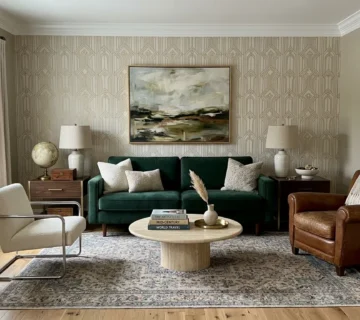
The condition of a writing desk is often lazily categorized into "messy equals creative" or "neat equals organized." The reality is far more nuanced. The desk is the cockpit of the home's intellectual life, and its state reflects how an individual processes information and tackles tasks. A pristine, minimalist desk with nothing but a monitor and a keyboard might indicate a person who needs absolute visual clarity to focus, someone who gets easily overwhelmed by external stimuli and requires a 'blank slate' to begin working. They likely compartmentalize their life vigorously. On the other hand, a desk covered in stacks of papers, open notebooks, and various artifacts—like the beautiful antique desk depicted in the image—isn't necessarily a sign of disorganization. For many, this 'clutter' is an externalized working memory. They need to see their projects physically laid out to make connections between them. It is controlled chaos, a physical manifestation of a mind that works best when surrounded by its ongoing projects.
Color Psychology and Moody Intellectualism
For years, the prevailing wisdom for home offices was to keep them bright, white, and sterile to promote alertness. We are now seeing a significant shift away from that clinical approach toward deeper, moodier, and more enveloping color palettes, as beautifully exemplified by the terracotta walls and deep green velvet chair in the featured image. This shift reflects a deeper understanding of what constitutes productive 'headspace.' While bright light is good for administrative tasks, deep thought, reading, and creative contemplation often flourish in environments that feel secure and enclosed. Rich, warm colors like burnt orange, deep teal, charcoal, or forest green create a cocoon-like effect. They don't shout for attention; they recede, allowing the mind to turn inward. A homeowner who chooses these shades for their private study is likely prioritizing comfort and deep focus over superficial alertness, valuing a space that feels like a warm embrace during long hours of mental work.
The Historical Shift: From Exclusion to Sanctuary
To understand the modern home study, we must acknowledge its history. Historically, the 'study' or 'library' was an intensely gendered space, exclusively the domain of the male head of household—a place to retreat from domestic life, smoke pipes, and conduct business. It was a space of privilege and exclusion. Today, the concept of this room has been radically democratized and redefined, especially in the wake of widespread remote work. It is no longer about exclusion, but about claiming necessary sanctuary for anyone in the home who needs it. It has morphed from a rigid symbol of patriarchal authority into a fluid, multi-functional space for creativity, remote employment, and personal development. The way a modern homeowner utilizes this history—perhaps by incorporating vintage furniture like a heavy wooden desk, yet softening it with accessible literature and comfortable textiles—shows a personality that respects the past while actively reshaping it to fit a modern, inclusive lifestyle.
The Necessity of Analog Anchors in a Digital World
In an era where almost all our work and entertainment is mediated through screens, the objects we choose to keep in our physical workspaces have taken on new significance. Look closely at a person's desk. Do they rely solely on digital tools, or are there analog anchors present? The presence of physical journals, fountain pens, paper calendars, and tactile objects—like the open journal and brass lamp in the image—signals a personality that recognizes the cognitive benefits of disconnecting. There is a growing body of research suggesting that handwriting engages different parts of the brain than typing, aiding memory and creative synthesis. A workspace that consciously incorporates these analog elements suggests a homeowner who values deliberate, slowed-down thought processes over frantic digital multitasking. They are using their environment to physically ground themselves against the ephemeral nature of digital work.
The "Thinking Chair": Comfort as a Productivity Tool
Too often, office design focuses entirely on ergonomic task chairs, ignoring the necessity of a different kind of seating. A truly revealing home study always includes what can be called the "thinking chair" or the reading corner. This is distinct from the desk chair. It is a place intended not for active output, but for passive intake and contemplation. The plush green velvet armchair with the soft throw blanket in the image is the perfect example. Its presence indicates a homeowner who understands that productivity isn't just about grinding away at a keyboard; it requires periods of rest, reading, and staring into space to let ideas percolate. If a home office lacks this element of softness, it may suggest a personality that struggles to switch off or views productivity solely through the lens of constant activity. The thinking chair is an admission that comfort is a necessary component of intellectual rigor.
Conclusion
Ultimately, the private study or home library is the one room where home design transcends mere decoration and becomes an exercise in self-reflection. It is a space that should not be designed to impress others, but to support the truest version of yourself. Whether your sanctuary is a moody, book-filled cavern reminiscent of a Victorian library or a light-filled, minimalist haven, its authenticity is its most valuable asset. By examining this space, we don't just see where you work; we see how you think, what you value, and how you nurture your inner world in an increasingly noisy outer one.

No comment